
Hello.
I am Director Jung-Hwang Information of Cleor Clinic Gangnam Branch.
Have you ever changed your angle while looking in the mirror when you tie your hair up, noticing your nape exposed?
The spot that was hidden by your collar is suddenly visible, and every time you wash your face, your fingertips keep gravitating toward the same spot.
Lesions that protrude above the surface like this are different in nature from flat pigmentation.
While blemishes or dark spots are conditions where pigment particles are spread within the skin, making an approach that disperses the color appropriate, skin tags, milia, flat warts, and raised moles are forms where the tissue itself has volume and has taken root.
Since lightening the color does not reduce the height, the approach must be different.
Therefore, a method of removing tissue layer by layer becomes an option.
Today, we will look at what the Gangnam CO2 laser treatment is, what its strengths are, and which lesions it is used for.
What is the Gangnam CO2 laser?
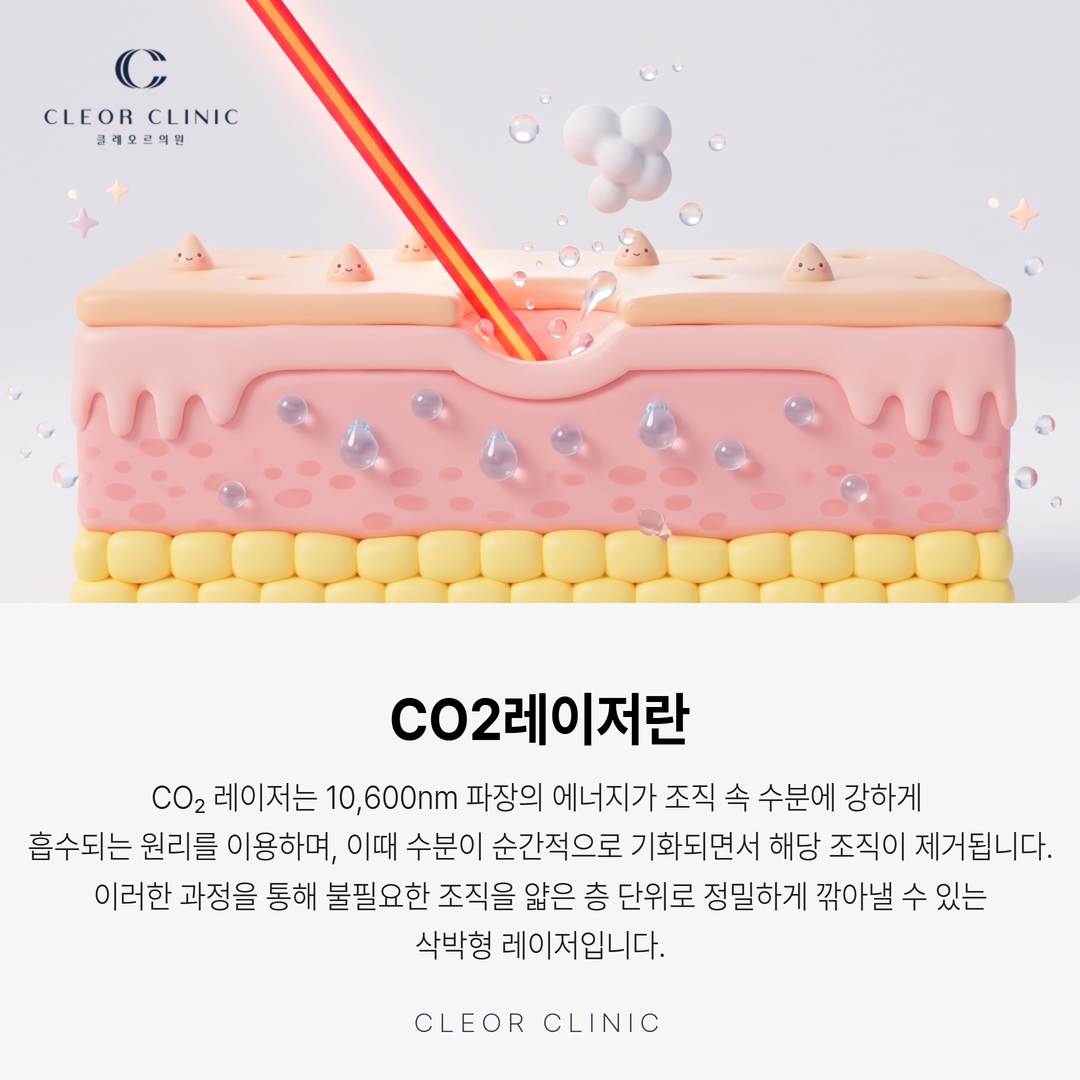
👉 The Gangnam CO2 laser is an ablative laser treatment that uses a 10600nm wavelength laser, which is absorbed by the moisture in the tissue, to instantly vaporize that area and precisely remove the tissue only to the desired depth.
How a laser works on the skin is determined by what its wavelength is absorbed by.
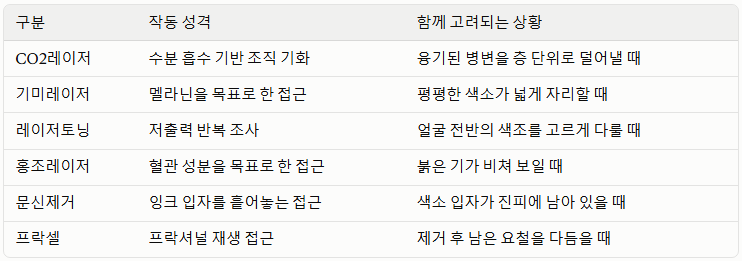
Lasers targeting pigmentation use wavelengths well-absorbed by melanin, and lasers targeting blood vessels use wavelengths well-absorbed by hemoglobin.
10600nm is a wavelength that is exceptionally well-absorbed by water.
The human skin is composed mostly of moisture.
Therefore, when energy of this wavelength touches the tissue, the moisture on the surface immediately absorbs it and boils instantly.
The tissue at that spot flies off in the form of water vapor and is removed.
This is called vaporization, and because it is a method of shaving off tissue in very thin layers, it is classified as ablative.
Strengths of the Gangnam CO2 laser
👉 The strength of this laser comes from the single property that the 10600nm wavelength is strongly absorbed by water.
First, the depth of removal is limited to be shallow.
The fact that it is well-absorbed by water also means that the energy is almost entirely consumed at the tissue surface and cannot penetrate deeply.
Since absorption ends at the outermost layer where the energy touches, the thickness removed in a single pass is kept thin.
This allows for a layer-by-layer approach.
This is why it is possible to operate by removing raised lesions layer by layer without digging down to the base at once, while visually checking the remaining thickness.
Second, there is minimal bleeding.
Immediately below the spot where vaporization occurs, heat remains in a very thin layer.
Because this residual heat coagulates micro-vessels to stop bleeding, the amount of blood flow is not significant, even though it is a procedure that actually removes tissue.The ability to proceed while checking the remaining tissue with a clear field of view leads to precision.
Third, it does not matter what the nature of the lesion is.
While pigment lasers only work if there is a target pigment, this method targets any tissue containing moisture.
Therefore, it has the strength of being able to treat lesions with different components in one place, such as moles with distinct pigment, milia with almost no color, skin-colored skin tags, and flat warts covered with thick keratin.
I will be honest about one thing.
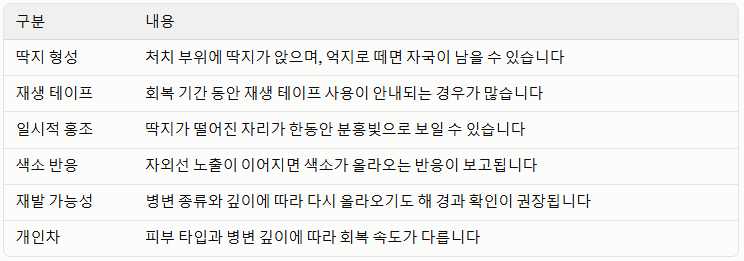
Because it is a method that actually removes tissue, a scab will form on that spot, and a healing period is required.
If you have an important schedule ahead, it is better to adjust the timing.
However, since this recovery period is a process that follows because the tissue was accurately removed, it is more accurate to approach it with its original strength of precisely treating raised lesions down to the base.
Operating principle of the CO2 laser
👉 The absorbed wavelength vaporizes the tissue, stops the bleeding, and then proceeds sequentially to the re-epithelialization stage.
When 10600nm energy touches the tissue, the moisture inside and outside the cells absorbs it, and the temperature rises rapidly.
The moment it exceeds the boiling point of water, the tissue of that layer escapes in the form of water vapor and fine particles, and the tissue that made up the lesion disappears by that much.
Since most of the energy is consumed in this process, the lower layers remain untouched.
Just below, the heat remaining after being used for vaporization lingers like a thin band.
This heat coagulates micro-vessels and proteins to reduce bleeding while leaving a damage signal on the tissue.
The practitioner observes this state to determine if any lesion remains and whether to proceed to the next layer.
The area where the treatment is finished is in a state where the epidermis has been peeled off.
The remaining normal epidermal cells around the edges move inward to cover the surface again.
This process is called re-epithelialization, and during this period, a scab protects the area.
If you force the scab off, the uncovered surface may be exposed, which can leave a mark, so care is taken to let it fall off naturally.
Procedure method and program
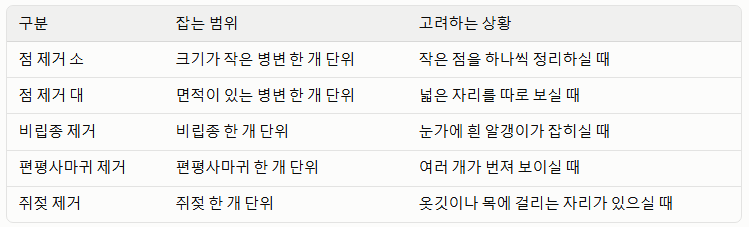
👉 The composition is divided based on the type and size of the lesion, and it is performed by setting the range in units of one.
At Cleor Clinic Gangnam Branch, this laser is used for lesions that protrude above the surface or have defined boundaries.
Moles, milia, flat warts, and skin tags have different layers and shapes where they occur, so the depth of removal is not the same.
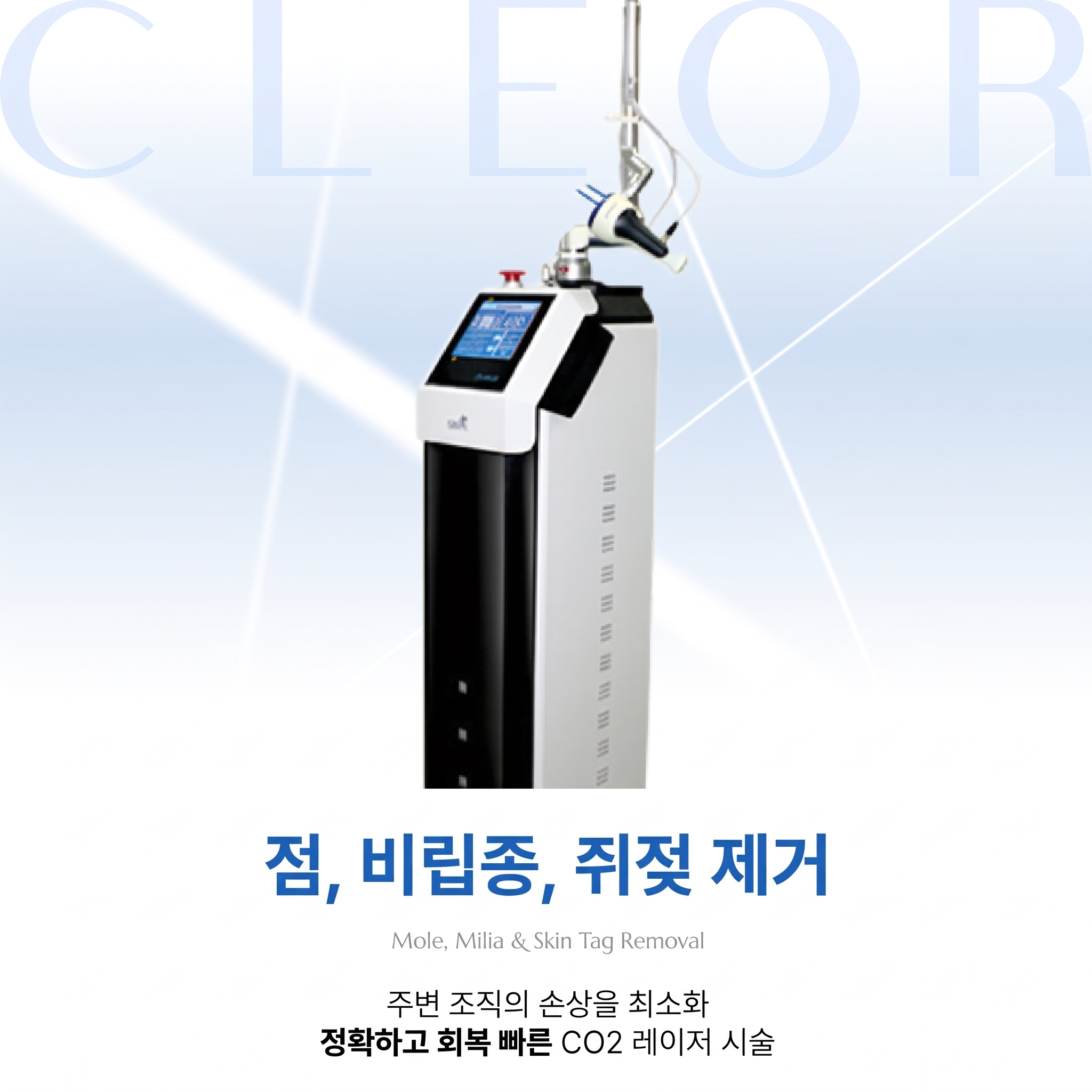
Therefore, even if the same laser is used, the settings are adjusted for each lesion.
Size is also a criterion for composition.
The larger the area, the more layers need to be passed through and the longer the period for the scab to form, so it is better to check your schedule first before deciding on the order.
Ranges that deal with pigment particles, such as tattoo removal, are operated as separate items.
Even with the same size, the range to be removed at once varies depending on how deep it is rooted.
How many to treat together and in what order to divide them are decided during the consultation after checking the shape of the lesion and your upcoming schedule.
Recommended for these people
Those who are constantly bothered by convex lesions that catch on their fingertips
Those who want to finally clear away moles they have been putting off removing
Those who are concerned about multiple skin tags or milia
Those who need a check-up because their flat warts are showing signs of spreading
Those who have secured a schedule that can accommodate the scab period
Types of Gangnam skin lasers
👉 Even with the same laser, the target varies depending on what the wavelength is absorbed by.
Side effects and things to know in advance
👉 This is a method that deals directly with tissue. The subsequent progress depends on how you manage the re-epithelialization period.
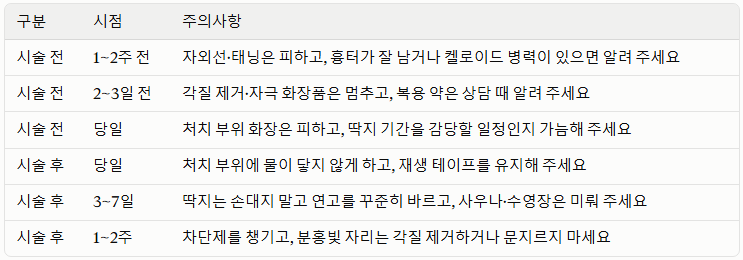
⚠️ Precautions before and after the procedure
❓ Frequently Asked Questions (FAQ)
Q. How is the CO2 laser different from a pigment laser?
A. A pigment laser uses a wavelength absorbed by melanin to disperse color, while this method uses a wavelength absorbed by water to remove the tissue itself, so the targets are different.
Q. How long does the scab last after the procedure?
A. It varies depending on the size, depth, and area of the lesion, and it is recommended to let it fall off naturally without forcing it off.
Q. Is it necessary to apply a hydrocolloid patch after the procedure?
A. It is often advised for the protection of the treated area and management of re-epithelialization, and the method varies depending on the area and condition.
Q. Can skin tags and milia also be treated?
A. Since any tissue containing moisture is a target, both lesions are considered, and if there are many, the area may be divided for treatment.
Q. Can a mole come back after removal?
A. There are cases where recurrence is reported depending on the depth at which the lesion is rooted, so we usually schedule a follow-up check.
Q. When can I wash my face?
A. Please be careful not to let water touch the area directly on the day of the procedure, and subsequent schedules will be guided according to the condition of the area.
The Gangnam CO2 laser is a treatment that uses the property that the 10600nm wavelength is strongly absorbed by water to precisely remove tissue in thin layers.
Its strengths are that the depth is limited to be shallow, allowing for a layer-by-layer approach, residual heat helps with hemostasis to reduce bleeding, and it can treat lesions with volume regardless of the presence of pigment.
At Cleor Clinic Gangnam Branch, we personally check during the consultation whether it is a suitable direction by examining the shape and depth of the lesion along with your daily schedule.
If there is a spot that has been bothering you for a long time, feel free to come in for a check-up.
※ This content is for general information purposes only, and changes may vary from person to person.
Please determine the exact diagnosis and whether to proceed with the procedure through a consultation with a specialist.
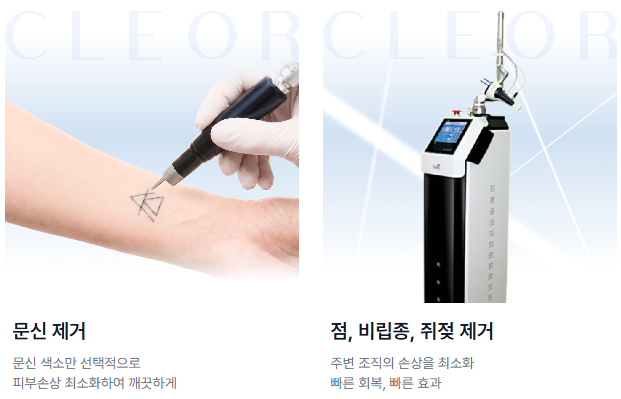
▼ Cleor CO2 Laser ▼
https://gangnam.cleorclinic.com/ko/treatments/피부/레이저%20제거
▼ Recommended Columns ▼
https://gangnam.cleorclinic.com/ko/about/posts/dY6VN4fFMxftoOS2uBur
❓ 자주 묻는 질문 (FAQ)
Q. CO2레이저는 색소 레이저와 무엇이 다른가요?
A. 색소 레이저는 멜라닌에 흡수되는 파장으로 색을 흩어놓고, 이 방식은 물에
흡수되는 파장으로 조직 자체를 덜어내기 때문에 다루는 대상이 서로 다릅니다.
Q. 시술 후 딱지는 얼마나 유지되나요?
A. 병변의 크기와 깊이, 부위에 따라 달라지며,
억지로 떼지 않고 자연히 떨어지도록 두는 쪽이 권장됩니다.
Q. 시술 후 재생 테이프는 꼭 붙여야 하나요?
A. 처치 부위 보호와 재상피화 관리를 위해 안내되는 경우가 많으며,
부위와 상태에 따라 방식은 달라집니다.
Q. 쥐젖과 비립종도 다룰 수 있나요?
A. 수분을 가진 조직이면 목표가 되므로 두 병변 모두 함께 고려되며,
개수가 많다면 부위를 나누어 진행하기도 합니다.
Q. 점제거 후 다시 올라올 수 있나요?
A. 병변이 자리 잡은 깊이에 따라 재발이 보고되는 사례가
있어 경과 확인을 함께 두는 편입니다.
Q. 세안은 언제부터 가능한가요?
A. 처치 당일에는 물이 직접 닿지 않도록 주의하시고,
이후 일정은 부위 상태에 따라 안내가 달라집니다.
강남 CO2레이저는 10600nm라는 파장이 물에 강하게 흡수된다는 성질을 이용해,
조직을 얇은 층 단위로 정밀하게 덜어내는 케어입니다.
깊이가 얕게 제한되어 층을 나누어 접근할 수 있고, 잔여 열이 지혈을 도와 출혈이 적으며,
색소 유무와 무관하게 부피를 가진 병변을 다룰 수 있다는 점이 강점입니다.
클레오르의원 강남점에서는 병변의 형태와 깊이,
생활 일정을 함께 살펴 적합한 방향인지 상담 시 직접 확인해 드립니다.
오래 신경 쓰이던 자리가 있으셨다면, 가벼운 마음으로 한 번 확인해 보셔도 좋겠습니다.
※ 본 내용은 일반적인 정보 제공을 위한 글이며, 개인에 따라 나타나는 변화는 달라질 수 있습니다.
정확한 진단과 시술 여부는 전문의 상담을 통해 판단하시기 바랍니다.
▼ 클레오르 CO2 레이저 ▼
https://gangnam.cleorclinic.com/ko/treatments/피부/레이저%20제거
▼ 함께 보면 좋은 칼럼 ▼
https://gangnam.cleorclinic.com/ko/about/posts/dY6VN4fFMxftoOS2uBur