
Hello.
I am Director Hwang Jeong-hwang of Cleor Clinic Gangnam Branch.
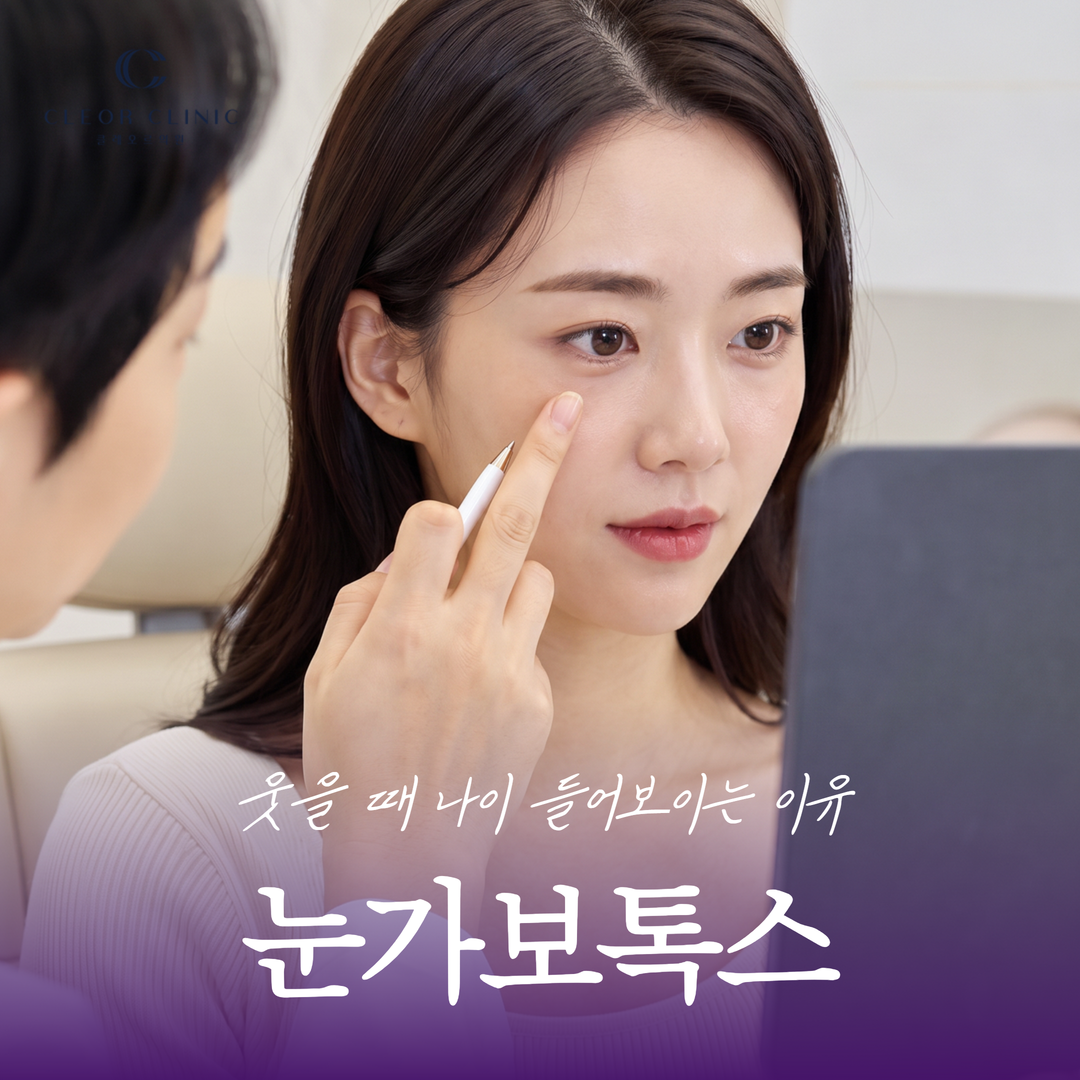
Have you ever tried adjusting the size of your smile in anticipation of taking a photo?
There are moments when you want to laugh freely, but you hold back your expression because you are preoccupied with how the corners of your eyes will crease.
Many people have mentioned the experience of seeing marks remain at the corners of their eyes for several seconds after laughing heartily.
Because the eye area is where we use facial expressions most frequently and the skin is thin, we notice changes here earlier than in other areas.
This is why the lines that form when smiling become a concern early on.
Today, I will explain why the eye area creases particularly early, and at what stage Gangnam eye Botox helps to alleviate that creasing.
What is Gangnam eye Botox?
👉 Gangnam eye Botox is a treatment that temporarily reduces the movement of the corners of the eyes when smiling or squinting by injecting botulinum toxin into the outer part of the orbicularis oculi muscle that surrounds the eyes.
The orbicularis oculi muscle has a unique arrangement among facial expression muscles.
Unlike other expression muscles that start from the bone and run in one direction, this muscle surrounds the eye in a ring shape, drawing concentric circles.
The inner eyelid part is used for closing the eyes gently, while the outer orbital part contracts strongly when closing the eyes tightly or smiling broadly.

Since the muscle fibers are arranged in a ring, the force during contraction tightens inward toward the eye.
The skin above it is pushed and gathered in a fan shape perpendicular to the ring, extending outward from the corners of the eyes.
The reason why eye wrinkles form in a radial pattern rather than vertically comes from this arrangement.
Skin conditions are also a factor here.
The skin around the eyes is among the thinnest in terms of the dermis on the face and has almost no subcutaneous fat layer, so it is close to a state where a thin membrane covers the muscle directly.
Even when pulled with the same force, the creasing is revealed on the surface, and the condition is exacerbated by the fact that it is prone to dryness due to fewer sebaceous glands.
Therefore, we look at the degree of creasing when smiling and the lines that remain after relaxing the face separately to determine the scope of treatment.
The principle of eye Botox
👉 It cuts off the signal that leads to ring-shaped contraction. Consequently, the frequency with which the eye area creases is reduced in turn.
The starting point is repetitive tightening.
The outer ring of the orbicularis oculi muscle contracts every time you smile, squint, or are dazzled by sunlight, tightening around the eyes.
Thin eye skin lacks a fat layer to cushion that force, so it creases immediately, and if this creasing is repeated for a long time, the elastic fibers of the dermis remain pressed along the direction of the crease.
Toxin does not shrink the muscle itself but temporarily cuts off the commands delivered to the muscle.
If neurotransmitters are not released from the nerve endings, the muscle fibers do not receive contraction commands, and the force tightening the ring weakens.
As the pulling force weakens, the fan-shaped lines extending to the outer corners of the eyes gather less.
In areas where the frequency of creasing is reduced, the dermis gains time to recover, and the time that marks remain after relaxing the expression tends to shorten.
As time passes and the nerve endings regain their function, movement gradually returns, so it is suitable for management that considers your expression habits.
A method where eye Botox only alleviates the creasing force
👉 We selectively treat only the outer part of the ring-shaped muscle. We leave the function of opening and closing the eyes intact and only alleviate the force that causes creasing.
First, the range can be divided.
The orbicularis oculi muscle has different roles for the inner and outer parts.
The basic function of closing and opening the eyes is handled by the inner eyelid part, while the force that creases the corners of the eyes when smiling comes from the outer orbital part.
Therefore, by targeting only the area corresponding to the outer ring, we can leave functions like blinking and tear drainage intact while only alleviating the force that causes the eye area to crease.
Second, we utilize the property of staying in the shallow layer.
The muscle in this area is attached shallowly just below the skin.
Therefore, it reaches the muscle fibers without needing to go deep.
The range over which the toxin spreads around the injection point is narrow.
So, by placing it shallowly and on the outside, we can approach it while keeping a distance from the muscle that lifts the eyelid.
Third, the action point is at the signal stage, so the creasing itself is reduced.
The light chain of the toxin cuts the SNARE protein that connects vesicles and cell membranes within the nerve endings.
If this mechanism does not work, even if vesicles containing acetylcholine reach the cell membrane, they cannot release their contents outside.
Muscle fibers that do not receive the neurotransmitter cannot tighten the eye area.
The frequency with which thin skin repeatedly creases in the same spot is reduced accordingly.
How it proceeds and the program

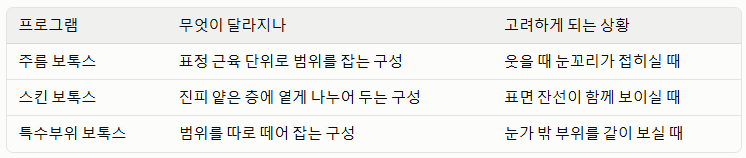
👉 It is a method of shallowly distributing botulinum toxin type A into the outer ring of the orbicularis oculi muscle, and the composition is divided into a range that looks at expression muscles and a range that looks at the surface.
The eye area is a place where the skin is thin and the muscle is attached just below the skin.
If you go deep, you can reach the force of closing your eyes, so we set the distribution to be shallowly divided into the outer ring.
When surface fine lines are also visible, we also look at the skin Botox range, which is very lightly distributed in the shallow layer of the dermis.
Since the creasing caused by expressions and the fine lines on the surface occur in different places, we tend to divide them rather than bundling them into one range.
Even in the same eye area, the division points vary depending on the force of closing the eyes and the way of smiling.
The extent of the range is determined during the consultation after observing you when you smile broadly and when you relax your face.
Types of Gangnam Botox
👉 Even with the same Botox, the composition varies depending on which part of the face is being treated.The range is set after checking the force of closing the eyes, the expression pattern when smiling, and the skin thickness.
This is why the distribution is not the same even for the same eye fine lines.
Side effects and things to know
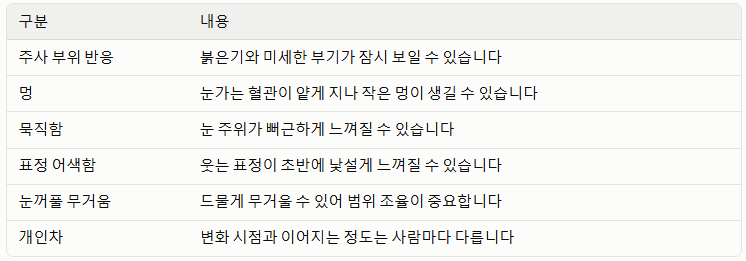
👉 It is reported that most things to know in advance are temporary reactions and often subside over time.
If you have ptosis, a history of surgery around the eyes, neuromuscular disease, or are pregnant or breastfeeding, we will check your condition first during the consultation stage.
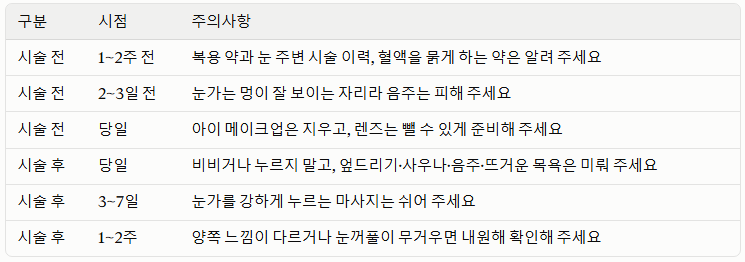
⚠️ Precautions before and after treatment
Recommended for those who:
Are bothered by marks remaining at the corners of their eyes for a while after smiling
Have eye fine lines that stand out particularly in photos
Have a habit of squinting, causing the same area to crease repeatedly
Have started to notice makeup clumping along the lines around their eyes
Want to tidy up their upper face impression along with glabellar Botox
❓ Frequently Asked Questions (FAQ)
Q. Doesn't Botox make my smiling expression look awkward?
A. We approach by targeting only the area corresponding to the outer ring, not the entire orbicularis oculi muscle.
We set a distribution that alleviates only excessive contraction while leaving the expression intact.
Q. Does it help with lines that remain even after relaxing the expression?
A. It has strengths in lowering the frequency of creasing caused by expressions.
If thin skin condition is the main cause, we also look at directions that treat the dermis together, such as the Rejuran line or skin Botox.
Q. Can the corners of my eyes droop?
A. Since it is an area close to the function of opening and closing the eyes, we carefully consider the depth and distance.
We go through a process of determining the outer range after directly checking your expressions.
Q. Do I bruise easily after the procedure?
A. The eye area is where blood vessels pass shallowly, so small bruises may be visible.
They fade over time, but it is better to avoid scheduling important events.
Q. Can eye Botox be received together with glabellar Botox?
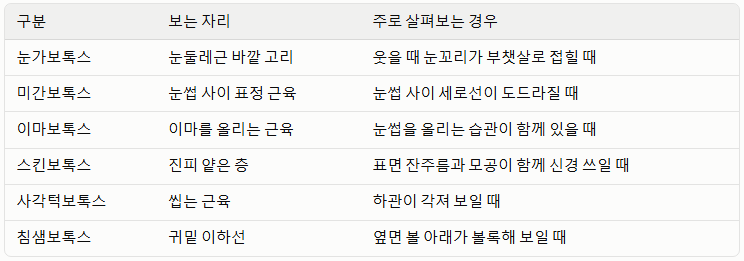
A. Upper facial expression muscles often interlock and move, so they are often treated together.
However, the distribution is set differently depending on the degree of the squinting habit.
Q. Can I wear contact lenses immediately on the day of the procedure?
A. On the day of the procedure, touching and pressing the eye area can be burdensome, so we recommend that you prepare glasses.
The eye area is where we use facial expressions most frequently and the skin is thin.
Gangnam eye Botox has the strength of helping the eye impression look comfortable even with a narrow range because it selectively alleviates the creasing force of only the outer part of the ring muscle surrounding the eyes.
Even for the same eye fine lines, the distribution is not the same because the force of closing the eyes, the way of smiling, and the skin thickness are different.
I will personally check which range is suitable during the consultation.
Since the approach to alleviating the creasing force and the approach to supporting the thinned skin are different for the eye area, it is better to divide and see which one is the priority now.
If you have any questions, please feel free to ask.
※ This content is for general information purposes only, and changes that appear may vary depending on the individual.
Please determine the exact diagnosis and whether to proceed with the procedure through a consultation with a specialist.
▼ Cleor Botox ▼
https://gangnam.cleorclinic.com/ko/treatments/컨투어링/보톡스
▼ Posts you might also like ▼
https://gangnam.cleorclinic.com/ko/about/posts/mJJkenQwlk2xHqQqXNA6
과한 수축만 덜어 내고 표정은 남겨 두는 배분을 잡습니다.
Q. 표정을 풀어도 남는 선에도 도움이 되나요?
A. 표정에서 비롯된 접힘 빈도를 낮추는 데 강점이 있습니다.
얇아진 피부 상태가 주된 원인이라면 리쥬란 계열이나
스킨보톡스처럼 진피를 함께 보는 방향을 나란히 살피기도 합니다.
Q. 눈꼬리가 처질 수 있나요?
A. 눈을 뜨고 감는 기능과 가까운 자리라 깊이와 거리를 신중하게 봅니다.
표정을 직접 확인한 뒤 바깥쪽 범위를 정하는 과정을 거칩니다.
Q. 시술 후에 멍이 잘 드나요?
A. 눈가는 혈관이 얕게 지나는 자리라 작은 멍이 보일 수 있습니다.
시간이 지나며 옅어지지만 중요한 일정은 피해 잡으시는 편이 좋습니다.
Q. 눈가보톡스는 미간보톡스와 함께 받아도 되나요?
A. 윗얼굴 표정근은 서로 맞물려 움직여 함께 보는 경우가 많습니다.
다만 찡그리는 습관의 정도에 따라 배분을 달리 잡습니다.
Q. 받은 날 렌즈를 바로 껴도 되나요?
A. 당일에는 눈가를 만지고 누르는 동작이 부담이
될 수 있어 안경을 준비해 오시기를 권해 드립니다.

눈가는 얼굴에서 표정을 가장 자주 쓰는 자리이면서 피부가 얇은 자리입니다.
강남 눈가보톡스는 눈을 둘러싼 고리 근육의 바깥쪽만 골라 접히는 힘을 덜어 내기 때문에,
좁은 범위로도 눈매 인상이 편안해 보이도록 돕는다는 강점이 있습니다.
같은 눈가 잔주름이어도 눈을 감는 힘과 웃는 방식,
피부 두께가 달라 배분이 같지 않습니다.
어떤 범위가 어울릴지는 상담 시 직접 확인해 드립니다.
눈가는 접히는 힘을 덜어 내는 쪽과 얇아진 피부를 받치는 쪽이
서로 다른 접근이라, 지금 어느 쪽이 먼저인지부터 나눠 보시는 편이 좋습니다.
궁금한 점이 있으시면 부담 없이 문의 주세요.
※ 본 내용은 일반적인 정보 제공을 위한 글이며, 개인에 따라 나타나는 변화는 달라질 수 있습니다.
정확한 진단과 시술 여부는 전문의 상담을 통해 판단하시기 바랍니다.
▼ 클레오르 보톡스 ▼
https://gangnam.cleorclinic.com/ko/treatments/컨투어링/보톡스
▼ 함께 보면 좋은 포스팅 ▼
https://gangnam.cleorclinic.com/ko/about/posts/mJJkenQwlk2xHqQqXNA6