

Hello.
I am Director Hwang Jeong-hwang of Cleor Clinic Gangnam Branch.
Have you ever sat by a window in the afternoon as the sunlight streams in from the side?
Areas beside your cheeks that were invisible under direct lighting often reveal themselves by casting shadows the moment light hits them at an angle.
The inflammation has subsided, but the marks remain.
The reason why indented marks persist even after the redness fades lies not on the skin surface, but beneath it.
The way collagen fills the dermis during the healing process determines the shape of the skin.
The reason topical products cannot cover these marks is that the changes remain deep within the dermis.
Therefore, for scars, we first categorize the shape before determining the approach.
Today, I will examine what Gangnam scar laser treatment is,
what its strengths are, and what types of marks it is used for.
What is Gangnam scar laser treatment?

👉 Gangnam scar laser treatment is a procedure that applies controlled micro-injuries to scar tissue that has become randomly tangled and accumulated,
restarting the wound healing process to guide collagen to rearrange in an organized direction.
In the dermis of normal skin, collagen fibers are woven densely in various directions,
maintaining an even surface.
On the other hand, when a wound heals rapidly, fibroblasts produce collagen quickly,
causing the fibers to clump or harden in a randomly tangled state.
When this accumulates excessively, it becomes a raised scar, and conversely, if the tissue is insufficiently filled, it becomes an indented scar.
Acne scars are divided into three types even within the indented category.
There is the ice-pick type, which is narrow at the entrance and deep and pointed at the bottom; the
rolling type, which has gently sloping walls and wide, undulating depressions; and the boxcar type, which has vertical walls and a flat bottom.
Because the depth and wall shapes differ, the target depth and the nature of the stimulation must also vary.
Strengths of Gangnam scar laser treatment
👉 The strength of this laser starts from the fact that scars are a problem of collagen arrangement.

First, we approach by categorizing the type.
The ice-pick type is narrow and deep, so if you only look at the surface area, you won't reach the bottom; the
rolling type is often caused by fibrous bands pulling the skin from below; and theboxcar type aims to make the vertical walls more gradual.
This is why we adjust the depth and density for each type, even on the same cheek.
Second, we intentionally restart the wound healing process.
Scar tissue that has already hardened does not rearrange itself over time.
When we apply controlled micro-injuries with a laser, the skin recognizes this as
a new wound and proceeds with the healing process from the beginning,activating fibroblasts to create new collagen.
This time, since it proceeds in a managed environment rather than an urgent inflammatory state,
there is room for the fibers to be placed in an organized direction.
Third, we leave normal tissue behind to assist in rearrangement.
The fractional method applies stimulation in dot units rather than the entire surface,
leaving untouched tissue between the dots.
The remaining normal dermis serves as the starting point for recovery and a standard for arrangement,
allowing the newly created collagen to settle along the surrounding structure.The reason we recommend dividing the treatment into sessions is that this rearrangement takes time.
Principles of scar laser
👉 This care begins with micro-injury.
After the inflammatory response and fibroblast activation, collagen is rearranged.
When the laser enters the scar area in dot units, the hardened tissue at those points
is cleared, leaving behind signals of micro-injury.

The skin reads this as a target for repair, triggers an initial inflammatory response,
and recruits cells necessary for recovery.
The temporary appearance of redness and swelling immediately after the procedure is a sign that this stage is in progress.
Subsequently, fibroblasts are activated to produce new collagen and elastic fibers.
At this time, the normal dermis left around the area serves as a standard for arrangement,
so that new fibers are placed in an organized direction along the existing structure rather than being randomly tangled.
In the indented areas, the lacking volume is gradually filled from the bottom up.
The newly created collagen changes into a more stable form over time, and its arrangement is organized.
As this process accumulates with each session, the depth of the indentation and the slope of the walls gradually become more gradual.
It is not a method of changing everything at once, but a method of layering the rearrangement multiple times,
so it is common to manage the treatment by observing the reaction at intervals and determining the next intensity.
Equipment and program configuration
👉 We use Potenza, Erbium Fraxel, and Genesis lasers, dividing them according to the shape of the marks,
and the configuration is divided into those that look at the dermis and those that look at the surface.
Potenza is a device that delivers radiofrequency directly to the dermis with fine needle tips.
It is structured to emit energy at the desired depth without the light being consumed while passing through the epidermis,
so it is used for areas where the lower arrangement is tangled, such as indented marks.
Erbium Fraxel is a device that creates micro-channels with a wavelength well-absorbed by moisture,
and the Genesis laser is a device that delivers only heat without touching the surface.
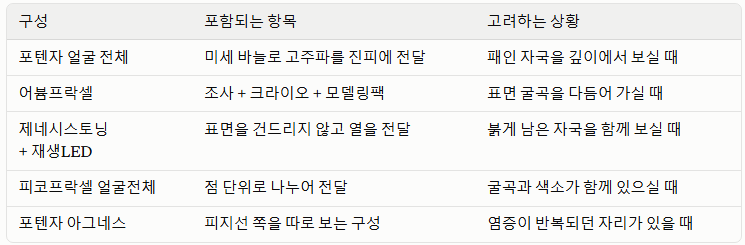
The areas we look at differ depending on whether the marks are still red or if only the texture remains.
Therefore, we change the configuration depending on the stage of the scar.
Even for the same mark, the layers we treat differ for raised shapes and indented shapes.
Which equipment to use and in what order is decided during the consultation after checking
the time the mark was formed and the depth of the surface irregularities.
If you are concerned about such marks
Those who are bothered by indented marks that remain even after acne has subsided
Those whose irregularities are particularly noticeable due to shadows in oblique light
Those who want to address both the irregularities and the pigmentation of the marks
Those who want to clear up old marks
Those who prefer to proceed in sessions rather than a strong treatment at once
Types of Gangnam skin lasers
👉 Scar care is divided into items with different operational characteristics depending on the type and depth of the mark.
Side effects and things to know
👉 This is care that goes through a regeneration process.
The subsequent progress depends on management during the recovery period and sun protection.
⚠️ Precautions before and after management
❓ Frequently Asked Questions (FAQ)

Q. Can it be applied to old scars?
A. Since hardened scar tissue does not organize itself over time,
even old marks become targets for restarting the healing process through micro-injury.

Q. Do you treat indented scars and raised scars together?

A. Since the areas where collagen is lacking and where it is excessively accumulated have opposite characteristics,
we tend to divide the items and intensity even within the same area.
Q. Does it proceed differently depending on the type of acne scar?
A. Since the ice-pick, rolling, and boxcar types have different depths and wall shapes,
we set the target depth and density according to the type.
Q. How are scar lasers and Potenza distinguished?
A. The method of delivering energy via light and the method of delivering radiofrequency via micro-needles
have different paths for stimulation.
Q. When can I wear makeup after the procedure?
A. It depends on the condition of the skin surface,
and it is recommended to postpone it while irritation remains.
Q. Is it finished in one session?
A. It takes time for the newly created collagen to settle into a stable form,
so it is common to manage it by building up sessions at intervals.
Gangnam scar laser treatment is care that views scars not as surface marks,
but as a problem of collagen arrangement.
We apply controlled micro-injuries to tissue that has hardened while randomly tangled to restart the wound healing process,
and guide new collagen to be placed in an organized direction using the remaining normal dermis as a standard.
This is why the order of categorizing the type first and then determining the depth and density is important.

At Cleor Clinic Gangnam Branch, we check the type, depth, and time of formation of the scar
during the consultation to confirm if it is a suitable direction.
If you have been bothered by marks that remained after the inflammation subsided,
please feel free to come in and talk about it.
※ This content is for general information purposes only, and changes may vary by individual.
Please determine the exact diagnosis and whether to proceed with the procedure through a consultation with a specialist.
▼ Cleor Scar Laser ▼
https://gangnam.cleorclinic.com/ko/treatments/피부/모공%20·%20흉터
▼ Recommended Columns ▼
https://gangnam.cleorclinic.com/ko/about/posts/HkyiTeNlXpVDx2SUZ75J
※ 본 내용은 일반적인 정보 제공을 위한 글이며, 개인에 따라 나타나는 변화는 달라질 수 있습니다.
정확한 진단과 시술 여부는 전문의 상담을 통해 판단하시기 바랍니다.
▼ 클레오르 흉터레이저 ▼
https://gangnam.cleorclinic.com/ko/treatments/피부/모공%20·%20흉터
▼ 함께 보면 좋은 칼럼 ▼
https://gangnam.cleorclinic.com/ko/about/posts/HkyiTeNlXpVDx2SUZ75J