
Hello.
I am Dr. Jeong Bo-hwang, Director of Cleor Clinic Gangnam Branch.
Have you ever stood in front of the mirror, gently lifted your face with both hands,
and let out a sigh?
"Just like a stretched-out cardigan shoulder, once it sags, it feels like it won't go back."
"There are so many lifting treatments that I don't know which one to get."
Ulthera, Shurink, Thermage, InMode, ONDA…
Just hearing the names can make your head spin.
Even though they are all lifting treatments, depending on the energy used,
who they suit and the direction of the results will differ.
Today, for those looking into Gangnam ultrasound lifting,
focusing on Ulthera and Shurink, as well as the differences from other lifting categories,
I'll share an honest breakdown.
Lifting procedures are categorized by energy
Non-surgical lifting performed at dermatology clinics
is divided into four categories depending on the energy used.

Although they all use the same word, "lifting,"
because the energy differs, the depth they reach, how they work, and the suitable results are all different.
The Gangnam ultrasound lifting we'll cover today is the first category among these,
a procedure area that utilizes HIFU ultrasound energy.

What is Gangnam Ultrasound Lifting
Gangnam ultrasound lifting
HIFU (High-Intensity Focused Ultrasound)
is a lifting procedure that utilizes this technology.
When ultrasound energy is focused on a single point, a tiny thermal coagulation point is created at that spot.
You can think of it like how paper scorches when sunlight is focused on a single point with a magnifying glass.
In the areas where thermal coagulation points are formed, the skin begins to generate new collagen to heal itself.
Procedures such as Ulthera, Shurink, TenTherma, and LinearFirm fall into this category.
Important Depth of Action — The SMAS Layer
The key to Gangnam ultrasound lifting
is that it reaches down to the SMAS layer (Superficial Musculo-Aponeurotic System).
The SMAS is a fascial layer located deeper than the dermis,
and it serves as the true support structure that holds up against facial sagging.
To use an analogy, rather than the fabric of a tent (the skin),
it can be seen as a procedure that acts on the poles supporting the tent (the SMAS).
The principle is that when the poles become firm again, the fabric naturally tightens as well.
Difference Between Ulthera and Shurink
These are two representative devices used for Gangnam ultrasound lifting.
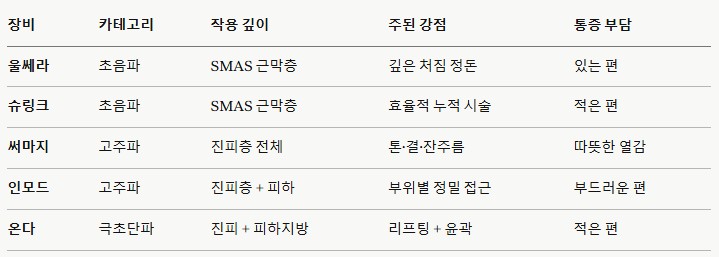
Ulthera
A device by Merz (USA)
US FDA-approved HIFU lifting device
Real-time visualization of the treatment area with ultrasound imaging (DeepSEE™)
Precisely reaches the deep SMAS layer
As the effect is strong, it tends to involve some pain
Shurink / Shurink Universe
Device manufactured by Classys (Korea)
Linear HIFU method (rapidly delivering multiple points simultaneously)
Short treatment time with relatively less pain
Provides steady results with cumulative treatments
Although both devices are ultrasound lifting treatments that reach the SMAS layer,
Ulthera is noted for its precision and intensity, while Shurink is valued for its efficiency and lower discomfort.
Differences from Other Lifting Categories
1) Radiofrequency (RF) Lifting (Thermage, InMode)
While Gangnam ultrasound lifting focuses on the depth of the SMAS layer,
radiofrequency lifting evenly distributes heat throughout the entire dermal layer.
Thermage
Device manufactured by Solta Medical (USA)
Heats the entire dermal layer using monopolar RF
Stimulates collagen regeneration from the skin's surface to the dermis
Effective for improving fine lines, pores, and skin texture
A category better suited for improving surface tone and texture rather than deep sagging
InMode
Device by InMode (Israel)
Combines RF + vacuum suction + various handpieces
Precise, targeted treatment by area
Frequently used on narrow areas such as around the eyes and mouth
2) Microwave Lifting (ONDA)
ONDA
Device by DEKA (Italy)
2.45GHz microwave technology
Acts simultaneously on the deep dermis and subcutaneous fat layer
3mm handpiece (focused on elasticity)
7mm handpiece (fat + contouring)
A treatment designed for simultaneous lifting and fat reduction
It reaches depths that ultrasound or radiofrequency cannot reach, and
it can also refine facial contours (double chin, jawline).
Which category suits my skin?
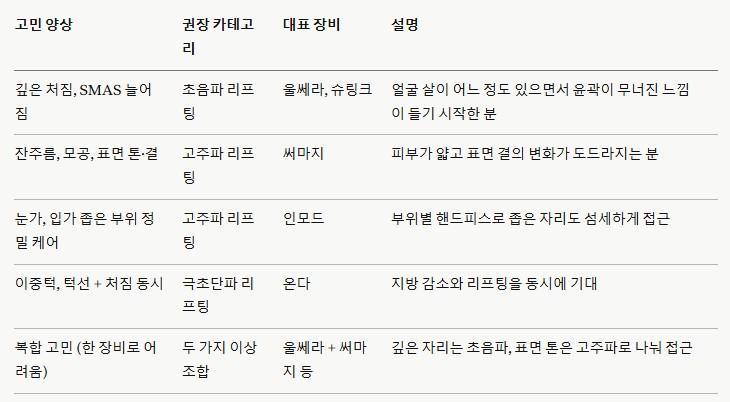
Even with sagging, the right option varies depending on its pattern.
Those concerned about deep sagging and SMAS laxity
→ Ultrasound Lifting (Ulthera, Shurink)
Suitable for those who have some facial volume and are starting to notice a loss of facial contour.
Those whose priority is improving fine lines, pores, and surface tone and texture
→ RF Lifting (Thermage)
Recommended for those with thin skin and noticeable changes in surface texture.
Those who need precision care for narrow areas such as around the eyes and mouth
→ RF Lifting (InMode)
With area-specific handpieces, even narrow areas can be treated delicately.
Those who want to refine both facial contours (double chin, jawline) and sagging
→ Microwave Lifting (ONDA)
This category offers both fat reduction and lifting.
Complex concerns that are difficult to address with a single device
→ Combination of two or more (e.g., Ulthera + Thermage)
A common approach is to target deep layers with ultrasound and surface tone with radiofrequency.
We will check this directly during your pre-treatment consultation.
Advantages of Gangnam Ultrasound Lifting
Deep lifting that reaches the SMAS fascia layer
A non-surgical category that directly addresses sagging
Relatively short procedure time of around 30 to 60 minutes
Minimal recovery burden, allowing return to daily life immediately after the procedure
Natural-looking results as it stimulates the body's own collagen production
Highly versatile for combining with other treatments
Who we recommend this for
Those who need to lift their face with both hands to see a more defined appearance
Those whose jawline has sagged, making their V-line less defined
Those whose nasolabial folds have deepened as their cheeks have sagged
Those who want to address sagging non-surgically
Those who want to achieve visible changes with a single recovery period
Those in their late 30s or older who are beginning to experience noticeable changes in skin elasticity
Cases that require prior consultation before treatment
If you are pregnant or breastfeeding
If you have active inflammation or a history of herpes in the treatment area
If you have metal implants (such as artificial joints or facial implants) in the treatment area
If you are using a pacemaker or other electrical medical devices
If you have a keloid-prone constitution
If you have been diagnosed with an autoimmune disease
If you are regularly taking anticoagulants
Depending on your skin condition and medication history, the treatment may not be suitable, so we will check directly during your pre-treatment consultation.
Pain and Recovery
Both Ulthera and Shurink are performed after applying numbing cream.
Because the stimulation reaches deep into the SMAS layer
This procedure is accompanied by a momentary stinging sensation and warmth.
Ulthera tends to involve more pain.
Shurink is known to be relatively less painful.
There may be slight redness and mild swelling immediately after the procedure.
Most of it subsides within a day to a few days.
Because the procedure stimulates deep tissue,
mild tenderness may remain for a few days in some cases.
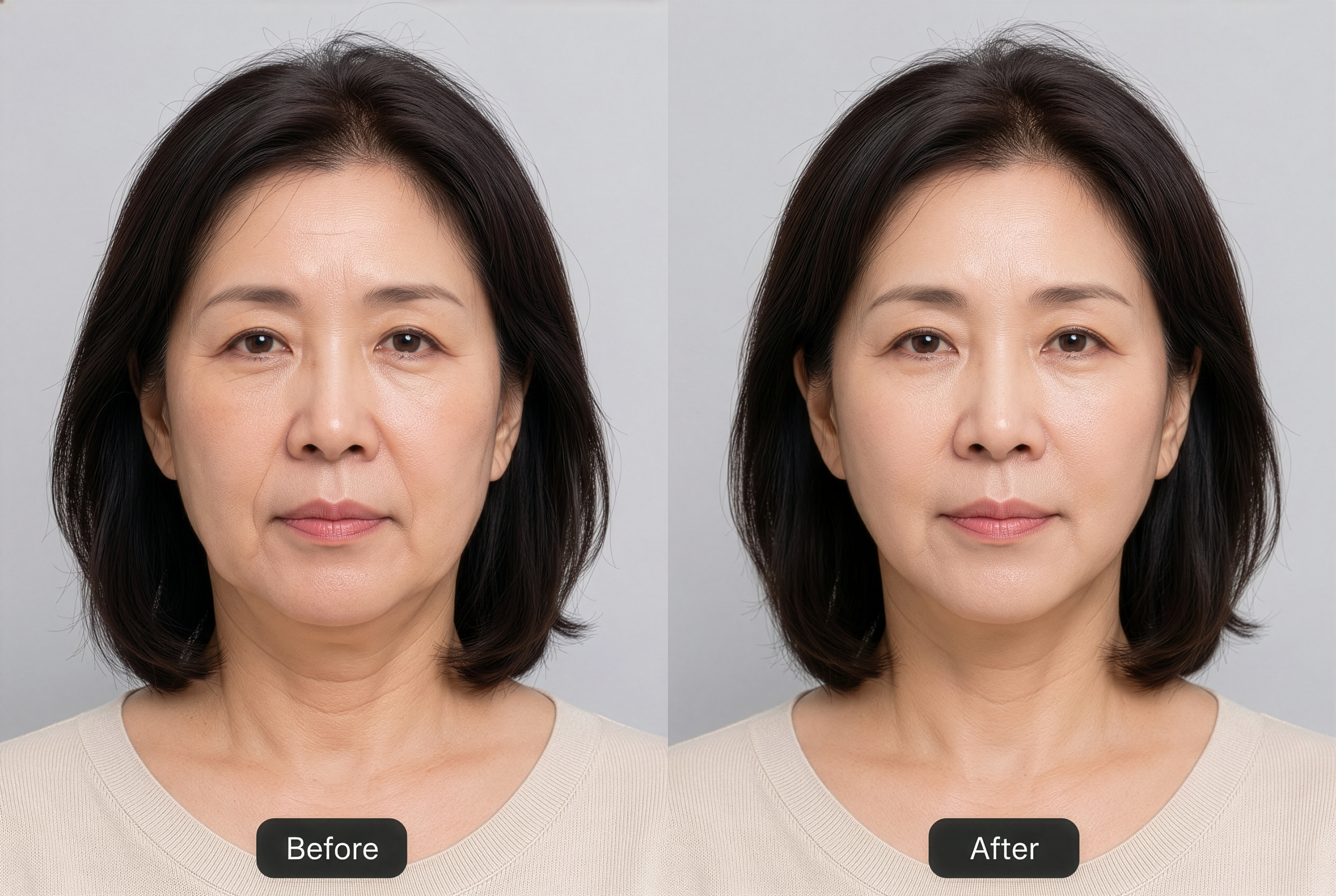
Ultrasound lifting is not an immediate procedure.
While there is a slightly refined impression immediately after the procedure,
the real change becomes most noticeable at 2 to 3 months when new collagen is produced.
It is a procedure where gradual changes continue for up to 6 months.
Step-by-step recovery guide after ultrasound lifting
Unlike other procedures, the recovery process over several days to months is important for ultrasound lifting.
⚠️ Precautions
Day of the procedure
Eat mainly soft foods. Mild tenderness may remain for a few days due to deep stimulation.
Avoid exaggerated facial expressions or opening your mouth wide
3 days after the procedure
Avoid alcohol
Avoid strenuous exercise, saunas, and jjimjilbangs (elevated body temperature can irritate recovery)
Avoid strong pressure on the treated area (sleeping position, pillows)
1 week after the procedure
Avoid strong massages and massaging devices
Gently care for the treated area with a cool mist or soothing care
2 to 3 months after the procedure
Active collagen regeneration period — consume sufficient water and protein
Apply sunscreen thoroughly every day (to prevent accelerated collagen breakdown)
Avoid extreme dieting or rapid weight changes (which may accelerate skin sagging again)
When an immediate clinic visit is required
Severe, persistent pain
When asymmetry in the treated area becomes noticeable
When temporary nerve numbness lasts for more than a few days
Gangnam ultrasound lifting is not a procedure that shows immediate changes.
Because the changes occur through collagen regeneration,
it takes about 2 to 3 months for the degree of change to become clear.
A single procedure will not resolve all sagging.
Depending on the sagging pattern and skin thickness, regular treatments about 1 to 2 times a year are recommended.
For those with very little facial fat or a weak SMAS layer itself,
Because ultrasound lifting alone has its limits, treatments such as fillers or
collagen boosters are sometimes considered together.
We will check this directly during your pre-treatment consultation.
❓ Frequently Asked Questions
Q. Which is better, Ulthera or Shurink?
Rather than one being better, they have different approaches.
Ulthera delivers stronger stimulation for a more defined result in a single session,
while Shurink is closer to a cumulative treatment with less intensive stimulation.
The right option depends on your sagging pattern and pain tolerance.
Q. Can I get it together with Thermage or ONDA?
Rather than doing them on the same day, they are often performed sequentially with an interval of several days to a few weeks.
It is possible to design a combination that firms the deep layers with ultrasound and refines the surface with radiofrequency or microwave.
Q. When will I start seeing changes after the treatment?
There is a slight tightening impression immediately after the procedure, but full results become most noticeable around 2 to 3 months.
It is a treatment that gradually builds volume and firmness up to 6 months.
Q. How long do the effects last?
It varies depending on individual skin condition, aging rate, UV care, and lifestyle habits.
On average, it is known to last about 1 year, and regular cumulative treatments are recommended.
Q. Is there a lifting treatment I can get without pain?
Among Gangnam ultrasound lifting treatments, Shurink is relatively less uncomfortable.
If you prefer a lifting treatment with less pain, the microwave category (ONDA) or
laser lifting (Titanium) may be a more suitable option.
Q. Are the results dramatic?
Rather than expecting a drastic change all at once, it is more accurate to expect a natural-looking refinement.
Because it is a non-surgical procedure, the extent of the results differs from a surgical facelift.
Q. What are the possible side effects?
Temporary redness, swelling, tenderness, mild bruising, and temporary numbness may occur.
Rarely, asymmetry, severe pain, or burns have been reported, making pre-treatment consultation and post-treatment monitoring important.
Even if lifting treatments sound similar,
the depth they reach and the results they achieve vary depending on the type of energy used.
Gangnam ultrasound lifting is a category that reaches down to the SMAS layer,
making it the most direct approach for addressing deep sagging.
There are two lines, Ulthera and Shurink,
and depending on the pattern of sagging, radiofrequency lifting such as Thermage or InMode,
or microwave lifting such as ONDA, which also targets fat reduction,
may be more suitable for some individuals.
If you are concerned about a sagging appearance,
please feel free to contact Cleor Clinic Gangnam Branch.
※ This content is for general informational purposes only, and results may vary depending on the individual.
Please consult with a specialist for an accurate diagnosis and to determine the appropriate treatment.
▼ Types of Lifting Treatments at Cleor ▼
▼ Recommended Columns ▼
https://gangnam.cleorclinic.com/ko/about/posts/0gevKirsY7yr50EERuXX