

Hello.
I am Dr. Bo-hwang Jung, Director of Cleor Clinic Gangnam Branch.
During hair removal consultations, some patients let us know in advance that they have white hairs mixed in.
When they search online, they see conflicting information saying both that it works and that it doesn't,
so they say they are confused about which side to believe.
However, the answer to this question does not come from whether the equipment is good or bad.
It comes from the fact that the target to which the laser delivers light is not the hair itself.
There must be pigment to absorb the light and convert it into heat, and white hair lacks that pigment.
Today, regarding the feasibility of white hair removal in Gangnam,
I will explain where hair color is determined and what conditions change as a result.

Where Hair Color Is Determined
👉 Hair color is not applied from the outside, but created at the root.
Pigment-producing cells are gathered inside the root, and as the hair grows upward, those cells supply the color.
This area is very narrow.
The spot that determines the color of a single hair is less than 1 millimeter.
Within a range as small as the tip of a ballpoint pen, it is decided whether that hair will grow out black.
As we age, the activity of these cells decreases, and the rate of decline varies from hair to hair.
Therefore, even within a single area, darkly pigmented hairs and depigmented hairs grow out mixed together.
This is why responses differ even in the same underarm or under-chin area.
What the Light Seeks
Laser hair removal is not a method of burning and cutting the hair.
Light is absorbed by pigment, converted into heat at that point,
and that heat is transferred to the structure that produces the hair.
Therefore, this process strictly requires pigment to receive the light.
Hairs with dense pigment absorb much more of the same light than the surrounding skin.
This establishes a structure where heat gathers only inside the hair while the surrounding area remains cool.
White hair is missing the first step of this structure.
Even when light enters, there is no pigment to capture it, so almost no heat is generated in that strand.
It is not the thickness or depth of the hair, but the presence or absence of pigment that changes the conditions.
Why We Do Not Simply Increase the Intensity
You might think that if there is no pigment, we can just send stronger light.
However, increasing the intensity does not increase absorption in that strand.
Where there is no pigment to receive it, increasing the amount of light simply passes through at the same rate.
What increases is the impact on the surrounding area.
Because the skin surface also contains pigment, raising the intensity increases the heat absorbed by the surface,
and areas with mixed white hairs often have uneven skin tone as well.
Therefore, when evaluating the feasibility of white hair removal in Gangnam, we do not start by turning up the intensity.
Instead, what we look at is how many hairs with remaining pigment are currently mixed into that area.
Strands that have completely lost their color and strands that still have pigment at the root have different conditions,
and that ratio within a single area also varies from person to person.
The Order of Pigment Loss
Hairs in one area do not lose their color at the same time or at the same rate.
Some people see lightening first in facial areas like the beard and eyebrows,
while body areas like the underarms or legs may retain pigment longer.
Thus, the conditions of an area treated last year and an area starting this year may be different.
Even if we apply the exact same settings that gave good results on a previously treated area,
if the hair color in that area has changed now, the response will not be the same.
This is why we check the hair color first when restarting sessions.
Some people lose pigment early due to genetics, and some have white hairs growing clustered in just one area.
Either way, hair removal does not include a method to reverse the underlying cause, so
we look at determining what is possible based on the current condition.
What happens when they are mixed
In areas where white and black hairs are mixed, as sessions accumulate, the hairs with remaining pigment decrease first.
As a result, the proportion of white hairs among the remaining hairs increases,
which can lead to a period where only the white hairs stand out more than before.
At this point, it is easy to feel that the results have worsened, but the total number of hairs is actually reduced.
This difference occurs because the reduced hairs and the remaining hairs are not perceived in the same proportion.
Therefore, checking the current ratio of hair colors in that area before proceeding
makes it easier to compare what changes as sessions accumulate.
There are individual differences in the degree of reduction and the number of sessions needed,
and in areas with many depigmented hairs, that difference becomes even greater.
Hairs with half-remaining pigment
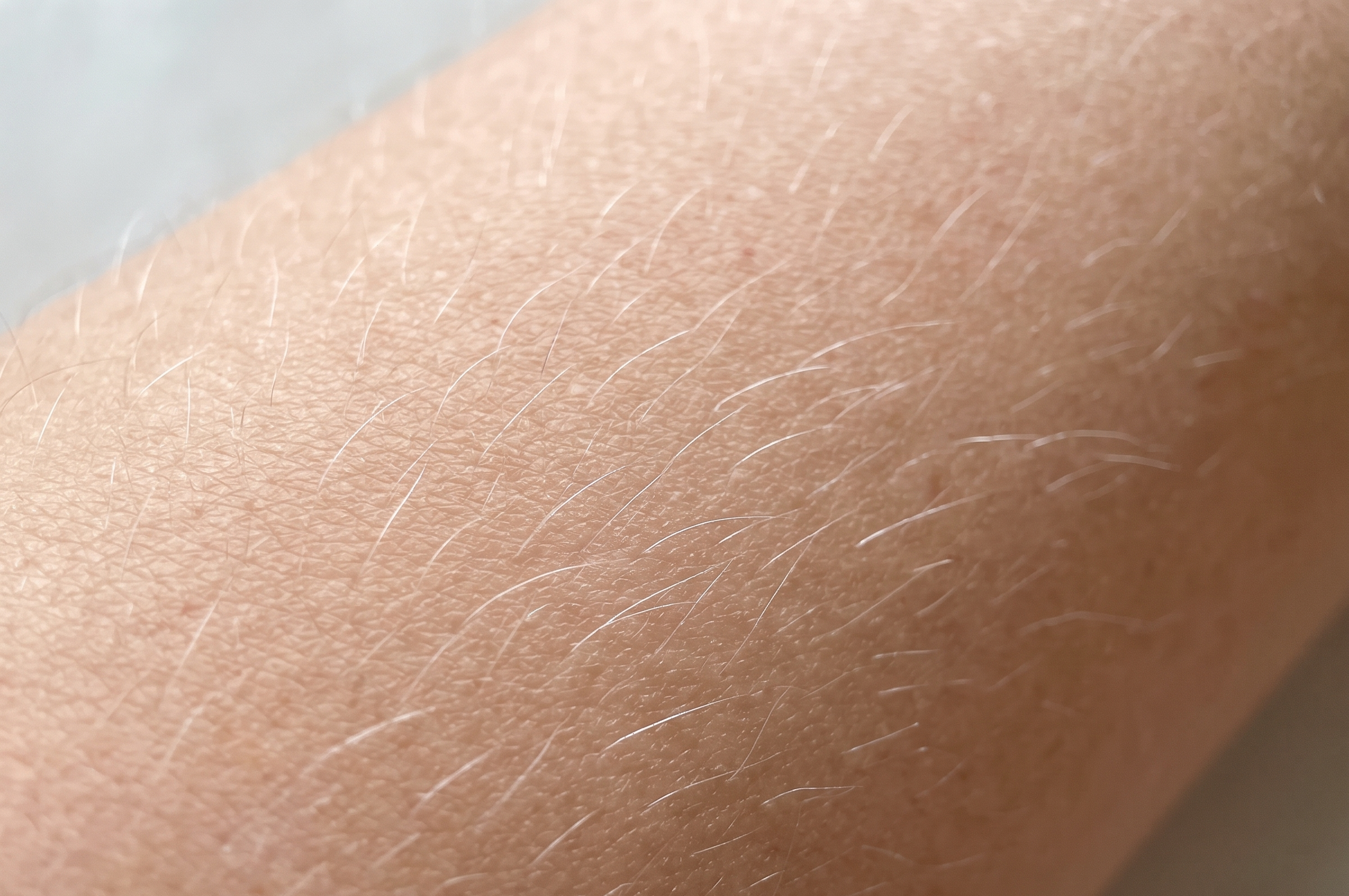
More often than not, hairs are not strictly divided into white and black.
Even within a single strand, there are hairs that still have pigment near the root and become lighter toward the tip.
These are hairs that grew out while the activity of pigment-producing cells was decreasing.
Such hairs still have a little pigment left for the light to catch.
However, depending on where and how much pigment remains, the point where heat is generated varies,
and it is difficult to expect the same results with the same settings used for densely pigmented hairs.
That is why we distinguish between hairs that look white to the eye and hairs that have lightened.
Under lighting, even light brown hairs can sometimes appear white.
Therefore, during the consultation, we look closely under bright light to check whether there is any remaining pigment.
This is usually where consultations regarding the feasibility of white hair removal in Gangnam take longer.
What we look at while accumulating sessions
If you decide to proceed, we also align in advance on what to monitor as we continue.
The first is the number of hairs growing back.
As pigmented hairs decrease, the overall number of hairs growing in the same area changes first.
The second is the thickness of the hairs.
Even if the same number grows back, if they are thinner than before, those hairs have responded.
The third is the area where the remaining white hairs are clustered.
If the area does not narrow and stays the same, that part is not a condition that can be changed by adjusting settings,
and we do not proceed with adding more sessions.
Comparing these three factors at each session makes it easier to judge how far to continue.
Deciding together when to stop rather than unnecessarily increasing sessions is also part of the consultation.
Order of checking conditions
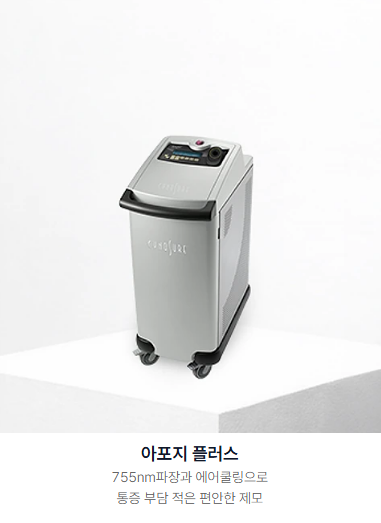
The device used for hair removal at Cleor Clinic Gangnam Branch is the Apogee Elite.
The separate listing of items by gender and area means that even for the same person,
hair and skin conditions vary by area, so settings are readjusted each time.
When consulting about white hair, we look at three things first.
How much pigmented hair is mixed in that area,
whether the white hairs are clustered in one spot or scattered,
and what the current skin tone of that area is.
Depending on these three factors, the number of sessions you can receive and the level of results you can expect will vary.
It is difficult to summarize simply as possible or not possible.
For white hair removal in Gangnam, the most accurate approach is to examine the area in person,
sort out the hair color first, and then decide together whether to schedule sessions.
⚠️ Precautions Before White Hair Removal in Gangnam
1–2 weeks prior, if you have a history of dyeing or bleaching that area, please let us know when it was done.
From 2–3 days prior, please do not pluck or remove white hairs with tweezers.
On the day of the procedure, please remove any color cosmetics and self-tanning products before coming in.
⚠️ Post-Treatment Care for White Hair Removal in Gangnam
On the day of the procedure, please avoid washing the treated area with hot water for a long time.
For 3 to 7 days after the procedure, shave any regrowing hair instead of plucking it.
At 1 to 2 weeks after the procedure, note how many areas have clusters of white hair.
Frequently Asked Questions (FAQ)
Q. If I start after checking whether white hair removal in Gangnam is possible, when will I start seeing changes?
A. Because hairs with remaining pigment respond first, those hairs will shed within a few days after the first session.
The point at which you feel the total number of hairs growing from the same area has decreased is usually after several sessions have accumulated.
Because hollow white hairs rarely follow that process,
the degree of reduction depends on how much pigmented hair is mixed in that area,
and the timing of noticeable results also varies from person to person.
Q. How do you decide how many sessions to do before stopping?
A. We evaluate three things at each session.
They are the number of hairs growing from the same area, the thickness of the regrown hair, and the extent of the area where remaining white hairs are clustered.
If the area does not narrow and remains the same, it is not a condition that can be changed through device settings,
so we do not proceed with adding more sessions, and the number of sessions needed and the timing to stop vary greatly from person to person.
Q. Does it also hurt in areas where only light-colored hair remains?
A. As long as pigmented hairs are mixed in, heat is generated in those hairs, so a stinging sensation comes with it.
As sessions accumulate and the number of pigmented hairs decreases,
some patients say they feel less irritation than before even at the same settings.
However, areas with mixed white hair often have uneven skin tone,
so we start at a lower intensity and increase it while observing the response.
Q. Can I wash up and go out right on the day of the procedure?
A. Washing lightly with lukewarm water is fine on the same day, and you can keep your outing plans as scheduled.
However, please refrain from washing with hot water for a long time.
Because the heat gathered in the pigmented hairs is spreading to the surrounding area, adding more heat will prolong redness.
Q. Do the hairs that responded not grow back again?
A. From roots where sufficient heat was delivered, the next hair grows back thinner and more slowly.
However, in areas where the activity of pigment-producing cells is decreasing,
a depigmented hair may newly grow in place of the hair that responded.
Therefore, when you come back after a long interval,
we do not simply reuse the previous settings; we check your current hair color first.
Q. Can I restart this year on an area I had treated last year?
A. The sessions you have already completed remain, so you can continue from there.
However, if the hair color in that area has changed in the meantime,
the response will not be the same even with settings that gave good results before.
The rate at which pigment fades differs for each hair, so some people see lightening on the face first while others
retain pigment on the body for longer; therefore, we re-evaluate each area before starting.
Q. If I dye or bleach white hair, will it absorb the light?
A. Dyeing and bleaching only change the color of the part that has grown above the skin.
The place where heat needs to be delivered is the root, and the color of that part does not change.
If you have dyed or bleached your hair, please let us know when you did it.


Whether white hair removal in Gangnam is possible is not a question divided by whether a device is good or bad.
It is a question of directly checking how much pigmented hair is mixed in that area
and where the white hairs are clustered,
and deciding together how far to continue.
If you have been hesitant to start because white hair is mixed in, it is best to first check the ratio of hair colors in that area right now.
During your consultation, we will directly check which areas to treat and under what conditions.
※ This content is provided for general informational purposes, and changes may vary depending on the individual.
Please consult with a medical specialist for an accurate diagnosis and to determine whether the procedure is appropriate for you.
▼ Cleor Hair Removal ▼
https://gangnam.cleorclinic.com/ko/treatments/제모%20·%20체형/여성%20제모
▼ Recommended Columns ▼
https://gangnam.cleorclinic.com/ko/about/posts/zqgdcPZV3OMZ6hbGT4fs